Monday, August 20, 2012

J2A Pilgrimage to Rome - Part 5 of 6


On Thursday, Kinsey, Alyson, and the rest of the J2A Pilgrimage Group headed on a day-long tour to Assisi.  We first stopped in Orvieto, one of the Etruscan walled cities in Umbria, “the Green Heart of Italy,” about an hour north of Rome.  If you have seen the film “Under the Tuscan Sun,” then you have seen an example of these walled cities.  The basilica pictured here is Duomo, which is an example of the Romanesque Gothic architecture.  You can see the style inside the basilica (which, like many other churches, did not allow photography inside) with the layers of the walls as they were built up.  The church looks worn and faded on the inside, especially compared to the Sistine Chapel and St. Peter’s Basilica we saw on Wednesday, but – in my opinion – it felt like a real church and not a spectacle.


We arrived in Orvieto before the basilica opened, so we had time to explore the town’s main street.  We ran into a number of beautiful ceramic shops, as well as a woodworking shop and a medieval collectibles store.  Kinsey and Allyson had espresso at a small bed-and-breakfast bar.


We stopped for a traditional Italian lunch at Podeze Bello, a farm located near Orvieto.  The antipasto (appetizer) was bruschetta, and the pasta dish was rigatoni in meat sauce (tomato sauce for the vegetarians).  The main course included salted veal, chicken, and lentils for the omnivores, while the herbivores had thick parmesan cheese and lentils.  The dessert was a wonderful Italian flan.  After the meal, we continued north to Assisi.


The first basilica we toured in Assisi was the Basilica di Santa Chiara, which houses the body of Saint Clare, the first female Franciscan monk and the founder of the Order of Poor Ladies.  It also contains a number of paintings from the 12th through 14th centuries, as well as the Crucifix that Saint Francis venerated at San Damiano.


St. Francis was credited with creating the first nativity scene.  The photograph shows the nativity set displayed outside in the Piazza di Santa Chiara.


St. Francis, who is well-known for starting the Order of Franciscan Monks, was actually born in a stable, where this photograph was taken.  Despite his humble beginnings, he was considered to be a playboy for his first 24 years of life, with aspirations of becoming a knight.  It was God that appeared to St. Francis in a vision to tell him to establish a church (and, eventually, the order of monks).


As we made our way into the Piazza Del Comune, which included an old Roman Temple to Minerva that has been converted to the Chiesa di Santa Maria sopra Minerva, and down the Via Portica, I was able to snap a long-distance shot of San Damiano, where St. Francis heard God’s voice and where he wrote the canticle of the Creatures.  Saint Claire used the building to found a convent.


The final basilica we toured in Assisi was the Basilica di Saint Francesco, which consists of two churches.  The upper church has colorful frescoes that show the major events in Saint Francis’ life, including his vow of poverty when he joined the church, when he received the stigmata, and two of the miracles attributed to him after his death.  The lower church has older frescoes that show the history of Jesus.  There is also a tomb below the lower church where the body of Saint Francis is laid.


The final stop on the tour was the Basilica di Santa Maria Degli Angeli, about 4 kilometers outside of Assisi.  A number of events happened in this church, including the recruiting of monks that would form the basis of the first Franciscan order, and the place were Saint Francis bestowed the Franciscan cowl to Saint Claire.


There is only one more day of sight-seeing on this pilgrimage, so stay tuned…

Thursday, August 2, 2012

J2A Pilgrimage to Rome - Part 4 of 6


We spent Wednesday touring Vatican City.  Our first stop was a General Audience with Pope Benedict XVI in the Pope Paul VI Auditorium.  We lined up outside the gate to the auditorium about 7:45 AM, where a crowd had already gathered.  We got through the gates (and the metal detectors) and made it inside the auditorium around 8:30 AM.


Because we got our invitations through the Bishop’s Office for United States Visitors to the Vatican, we had really good seats, about five rows away from the stage.  This picture shows the sculpture that formed the backdrop for the papal presentation.  There was a two-hour wait between when we arrived and when the general audience began, so we spent the time looking at the cardinals as they arrived and listening to all the chants, songs, and cheers from the Roman Catholic pilgrims of many nationalities.


And then Pope Benedict XVI arrived.  When the General Audience was described to us as a “papal pep rally,” they were not kidding.  The audience started with a prayer, followed by a reading of the letter of St. Paul to the Philippians in seven different languages:  Italian, French, English, German, Spanish, Portuguese, and Russian.  The Pope then continued a series of lessons about prayer that he started earlier this year.  Then pilgrims were introduced to the Pope in each of the seven native languages, and the Pope returned a greeting in each language.  A final prayer was read in Latin, and the Pope gave his blessing to all who attended, their families, and their friends.  So please consider yourself blessed!


The Pope also blessed any religious item brought by any member of the audience.  This included this gold-colored statue that was sitting on the stage to the left of the Pope.  We happened to run into it again after lunch when this picture was snapped.


We spent a little time in St. Peter’s Square, taking pictures of the Egyptian obelisk and the two fountains on the other side.  Here is a picture of Connie Badger in front of St. Peter’s Basilica.  Continuing once again on the “Angels and Demons” theme, St. Peter’s Basilica and Square was what Dan Brown used to symbolize the Air-based Altar of Science.


We then went on a guided tour of the Vatican Museum and Sistine Chapel.  It was a rather hectic tour, as the Vatican Museum hosts a number of amazing art pieces, but was built to allow only 30 viewers in a room at a time.  For a museum that gets over 13,000 visitors a day, it leads to a crowded museum all day long.  The Sistine Chapel was just as busy, but the paintings that cover the walls and ceiling of the chapel are breathtaking.  Unfortunately, they did not allow any photography within the Sistine Chapel, so we do not have any photos from there.


We finished our day walking around St. Peter’s Basilica, which is the main church in Vatican City. This photograph shows the high altar in the distance under rays of light, under which St. Peter is buried. The dome above the altar, which Michelangelo started in 1546, and Della Porta and Fontana finished in 1589, is huge, stretching out 92 meters into the sky. 


A shot straight up the dome. You can tell that I really like having rays of light in my pictures.


Located in the first nave on the right from the entrance is Michelangelo’s “Pieta.” The statue of the murdered Jesus stretched across the Virgin Mary’s lap was sculpted between 1498 and 1499, and Michelangelo signed the work across the Virgin Mary’s sash. We took plenty of pictures within St. Peter’s Basilica, but after a hard week of phototaking, my camera batteries decided that enough was enough. 


So the camera batteries are now charging as we prepare for an all-day trip to Assisi on Thursday. Stay tuned…  

Monday, July 2, 2012

J2A Pilgrimage to Rome - Part 3 of 6


Tuesday's adventure began with a visit to St. Paul's Within The Walls, probably the most well-known Episcopal Church in Rome.  The church was built in 1873, using architectural designs created by George Edmund Street, and it stands today hidden in the shadow of the Teatro della Opera.  We included this shot because it reflected the neighborhood around the church.


The beautiful mosaics in the church were designed by British artists Sir Edward Burne-Jones and William Morris, as well as the American artist George Breck.  This picture shows just part of the mural that celebrates the birth of Jesus Christ.


The stained glass windows around the church are amazingly gorgeous.  From the right side to the left side of the church, they tell the story of St. Paul.  This window shows the martyrdom of St. Paul, with his death by beheading at the Tre Fontane.  So why were the fans there?  Well, as luck would have it, we came to the church just as it was being prepared for a wedding that afternoon.  We eventually snuck out of the church while they were photographing the bride and the groom.


Our next stop was the church of Santa Maria della Vittoria.  The front of the church is undergoing construction (and apparently has been for a while), so we had to enter through the side entrance, which Alyson stands before in the picture.  Continuing the Angels and Demons theme from Sunday, this church was what Dan Brown used as the Fire-based Altar of Science.


The inside of the sanctuary is beautifully decorated with many religious images, focused mainly on the Virgin Mary.  The church originally started as a church dedicated to St. Paul, but it was changed to the Virgin Mary in 1620 after the Catholic victory at the Battle of White Mountain.  The church contains works by such artists as Bernini, Guercino, and Domenichino.  This picture shows a minor statue of the Virgin Mary.


We then trekked across the city to the Anglican Centre for a 12:45 PM Eucharist service and luncheon.  The Centre was founded in 1966 to build communications between the Roman Catholic Church and the Anglican Community, following a landmark meeting between Pope Paul VI and the Archbishop of Canterbury Michael Ramsey.  The Centre is located on the second floor of a museum and is rather difficult to find.  This photograph represents the first image of the Centre as you walk in: a massive library of Anglican religious literature.


Here is a picture of the sanctuary inside the Anglican Centre.  There was about 20 attendees at the service (including us), and there was a nice lunch afterwards where we got to talk with the ìregulars.î  The crowd was a mixture of retired Americans, foreign college students studying in Rome, and newly transplanted Americans.  I donít think they see a lot of pilgrimages coming through.  B)


After lunch, we worked our way back to the Trevi Fountain area, snapping photographs of fountains along the way, and stopped by The Pontifical North American College, which houses a number of Roman Catholic priests from the United States who are studying in Rome.  It was here that we picked up our tickets for the Papal General Audience for Wednesday.


We will let you know how that goes in our next update.

J2A Pilgrimage to Rome - Part 2 of 6


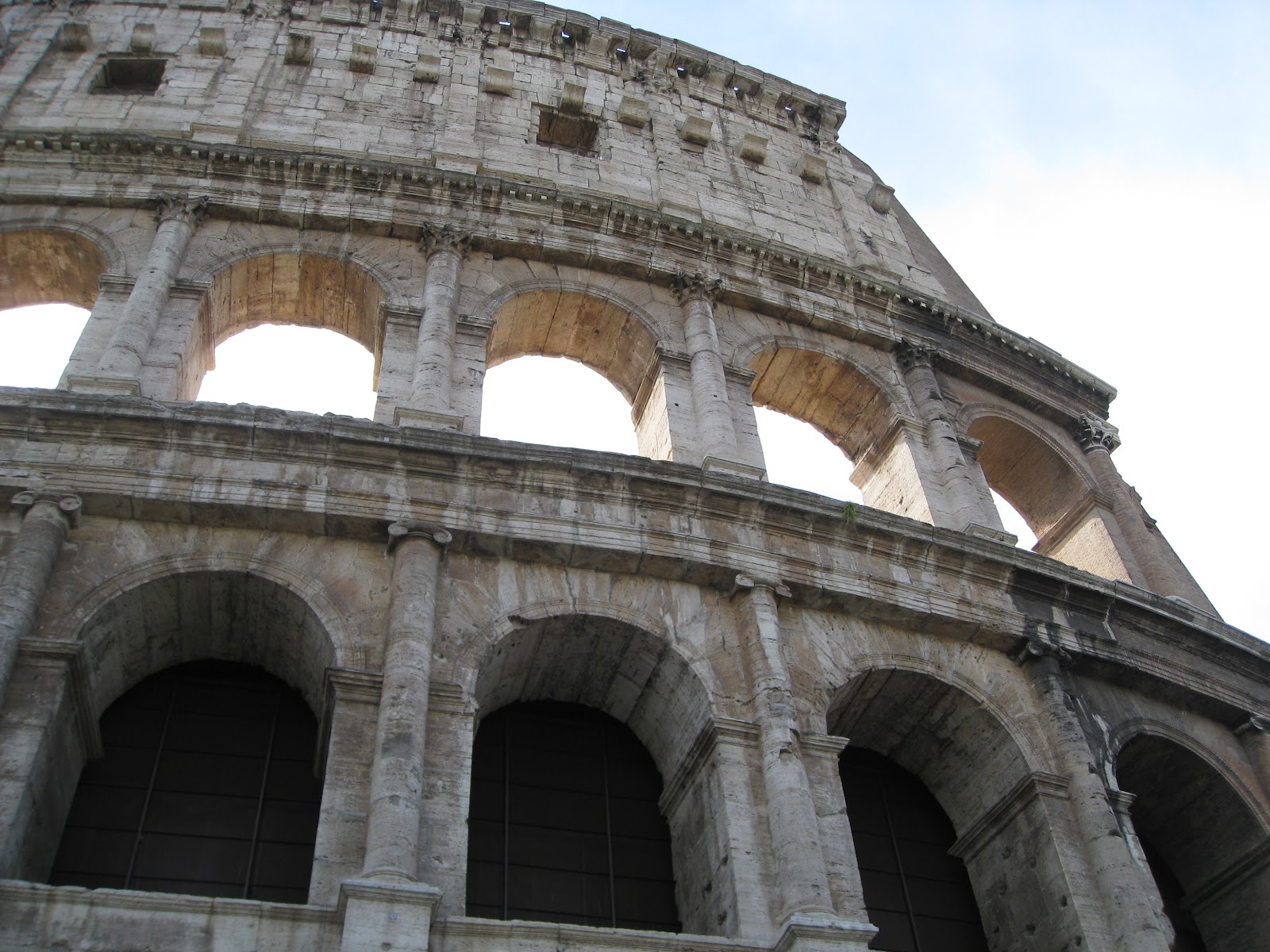
Our first destination on Monday was the Flavian Amphitheatre, better known as The Colosseum.  A project that took eight years and two emperors (Vespasian and Titus) to build, it would become the home to the greatest spectacles that Rome had to offer:  gladiatorial combat, naval battles, and religious executions.

This picture was taken from the area where the emperor of Rome would sit during the Colosseum events.  The bottom set of ruins represents the storage rooms and apartments built underneath the main floor of the Colosseum, which eliminated the naval battles because you could no longer flood the arena’s basement.  The crumbling white marble seats in the center of the picture showed where the Roman nobles sat during the events.  The whole Colosseum was decked out in marble when it was built, but the marble was removed and turned into limestone that was used to rebuild Rome after many of its wars.


The cross seen in this picture was erected to remember the many Christian martyrs that died within the Colosseum.  This cross was erected in the year 2000 AD, long after the final Christian was executed.  There were no memorials for the many Jewish prisoners that died building the Colosseum.


Our next stop was the Palatine, a huge hill that served as the home to many palaces of Roam patricians and emperors.  The area pictured here used to be the Circus of Domitian, a large oval track that used to host chariot races.  The columns in the ruins showed the three levels that old Roman architecture followed:  start with cement, cover with bricks, and then cover with marble.


From atop the Palatine, you could look down on the remains of the Roman Forum, which was the center of the city’s public life in ancient times.  We briefly got to visit the ruins of the Forum, but the heat exhausted us too much to continue.  By the way, despite what Shakespeare said, Julius Caesar was not killed on the steps of the Roman Forum.  (The Forum had burned down four years before Caesar’s death.)  Caesar was actually killed at the Theatre of Pompey, where we were on Sunday.


The remains of the Theatre of Pompey, as well as four Republican temples, could be found at the Largo di Torre Argentina.  The area currently serves as one of the largest no-kill cat shelters in Europe.


I don’t think where the feral cat is washing itself was the spot where Julius Caesar was executed, but it makes for a good story.


Unfortunately, the middle of Monday heralded two unpleasant events.  First, the credit card that was created specifically for this overseas pilgrimage stopped working.  Second, the service we received at the restaurant was incredibly bad.  We headed back to our hotel in the afternoon, but not before Alyson, Kinsey, and I headed out on a trek to find a post office to mail out postcards.

The trek ended up with us walking around the entire Vatican City, which is an actual country in itself.  Not many people can say they walked around an entire country during an afternoon.

We found a nearby restaurant dinner that more than washed away the unpleasant memories from lunch.

More posts to come…

Saturday, June 30, 2012

J2A Pilgrimage to Rome - Part 1 of 6


Our journey to Rome began at 2:00 PM on Friday from National Airport.  After several delays caused by thunderstorms on the East Coast, especially in Montreal, we made it to Rome at 12:30 PM on Saturday (which would have been 6:30 AM back in Annandale).  Alyson enjoyed her first two trips on an airplane, despite the turbulence, but Kinsey was the only one who managed to get more than two hours of sleep on the overnight trip.  We took the Leonardo Express from the Fiumicino Airport to the Termini station, and then took the Metro Line A over to Valle Aurelia.  And that led to our first big surprise.


Google Maps told us the best way to get to our monastery hotel was through Clivo delle Mura Vaticane.  What is pictured is the last part of the street.  Lots and lots and lots of stairs.  Just imagine the five of us dragging our suitcases up all those stairs.  Then we took a wrong turn on Via di Porta Pertusa and roughly doubled the distance it took to get the hotel.  We finally arrived to the hotel about 5:00 PM very tired and very sleepy.  All we had the energy left to do was find dinner.


The Pizzeria Rosticceria was the first pleasant surprise for the trip.  It is a local neighborhood pizzeria that serves a lot of good pizza (many of them vegetarian-friendly), as well as lasagna, calzones, and a number of cold pasta dishes.  It also had an air-conditioned basement that felt really good after a hot day of walking.  We came back on Sunday night since it was one of the few restaurants still open.

Sunday started with a guided tour of catacombs and the churches during the time of Early Christianity.  The day began with the Catacombs of San Callisto, which started as a series of caves formed from volcanic rock and turned into a four-level tier of catacombs stretching over 30 kilometers wide.  Nine of the popes were buried here until St. Peter’s Basilica was built and the bodies were moved there.  There is a monument to Saint Cecilia in the tomb, as well as a number of the original frescos from the first tier of the tomb.  Unfortunately, no photography was allowed in the catacombs (or in the churches we later visited on the tour).


We moved on to the Basilica di San Clemente, which is an 11th century Catholic basilica (which still holds masses at 11:00 AM on Sunday mornings), built atop a 4th century home of a Roman nobleman that was converted into a church, which itself was built atop the ruins of a 1st century house that was burned down as part of Nero’s Great Fire.  Archaeologists excavated down into both layers underneath the church so you can walk down and explore Rome’s past.


We toured the Church of the Santi Quattro Coronati, which more resembles a fortress than it does a church.  We watched part of a Roman Catholic Mass at the church, heard the Lord’s Prayer in Italian, and heard the order of the nuns that serve and live at the church sing hymns.


Our first stop after the tour was the Trevi Fountain and the huge marketplace that has sprung around the fountain.  The fountain is beautiful, and no one single photograph that I took can show its beauty.


Kinsey and Alyson gleefully toss their coins into the Trevi Fountain. 


We wandered west through the Italian marketplace and wound up at the Pantheon.  The Pantheon started its life as a temple to the Roman Gods, but in the 7th century, was converted into a Roman Catholic church called Santa Maria della Rotunda  (St. Mary and the Martyrs).
A painting of the Virgin Mary inside the Pantheon. Our final destination for the afternoon was the Piazza Navona, which is home to the Fontana dei Quattro Fiumi, or the Fountain of the Four Rivers.  The fountain was built in 1651 to immortalize the four “River Gods”: Ganges, Nile, Danube, and the Rio de la Plata.  The photograph shows the base of the fountain, which is topped by an Egyptian obelisk (one of four such obelisks in Rome; we spied the second obelisk fountain outside the Pantheon). Kinsey poses on the side of the Fountain of the Four Rivers.  For you Dan Brown fans out there, in his novel, “Angels and Demons,” the fountain was the Water-based Altar of Science.

We are now exhausted from a full day of sight-seeing, so we are going to get some sleep.  Stay tuned for more posts from Rome.

Sunday, June 17, 2012

Happy Fathers’ Day!

There are times when we as parents must do things we feel are in the best interest of our children but run counter to our kids' desires. For example, Madison (my toddler) wanted her Chapstick, but when we gave it to her without the cap, we were greeted with a thermonuclear meltdown. She didn't understand why she couldn't have the cap. She just knew she wanted the cap, but we weren't letting her have it.

"Which one of you would hand his son a stone when he asks for a loaf of bread, or a snake when he asks for a fish? If you then, who are wicked, know how to give good gifts to your children, how much more will your heavenly Father give good things to those who ask him." 

Matthew 7:9-11

My children are ages 12, 9, and 2. The range in their ages affords me with a couple of benefits. I'm able to capitalize on the lessons I've learned so far while parenting Trey and Alli, my older kids. 

Instead of automatically telling Madison, "No," I articulate what it is that I want her to do. When she plays too rough with the cats, I say, "Rub Amelia gently, like this," and then I show her what I mean. I'm also able to apply the new techniques I'm learning with Madison to interact more effectively with Trey and Alli. As they grow older and are more influenced by their own social networks, it behooved me to be more creative in how I communicate with them. Instead of relying on dinner conversations, I complement our communication by sending them my thoughts in emails and text messages.

Regardless of the particular methods you use to parent your own children, rely on our heavenly Father to be a leader in your household. Although I was born with original sin, I was also blessed to be born with a brilliant example of fatherhood in my own father. I have modeled my outlook to parenting on his resilient demeanor. Even still, I know that I parent imperfectly, yet I understand how to love my children. As their father, I relish in my role as their protector, their guardian. I know that my influence in their lives will continue to place me at the crossroads between bliss and tantrum. In the case of Madison, she melted down for the cap, but she also melts my heart when she says, "Dank you, Daddee!"

To all of my fellow fathers in the world, Happy Fathers’ Day! I tip my hat to you for stepping up to the challenge as well as to the rewards of parenthood. Take advantage of this day. Rejoice in the memories of when your children refused your help with putting on their shoes (at least initially), and celebrate when they aggressively reached for your hand to walk up and down the stairs. The best gift we can give our family is love, and today is one day in the year dedicated to their love for you.

Amen.

By Allen Gradnigo

Wednesday, June 13, 2012

A Community of Faith and Love

When you go to a house of worship as an adult, it is intentional. It is a conscious choice. If you attend services, why do you go?

I attend church at St. Barnabas’ Episcopal Church for several reasons. Today I will share one. There is a sense of community and common purpose in the midst of a congregation like this one that is hard to find elsewhere. I have developed friendships at church, and my family members have friends here too. We do volunteer work together, we share meals, we laugh and have fun, and we care for each other during the hard times. In fact, it is during hard times that I most appreciate and cherish my kinship with friends and loved ones, and my relationship with God.

Community is not limited to your friendly, local house of worship. Being in communion with people around the world is another way we demonstrate our faith. One of the five “Marks of Mission” of the Episcopal Church is “to respond to human need by loving service.”

Every Episcopal church I have attended has performed service projects and fundraising for their local communities and people in need across the globe. At St. Barnabas, service and mission work is varied and plentiful. It includes hosting an afterschool program for at-risk youth, helping staff and supply a local food bank in partnership with other churches, and organizing mission trips to Cuba and Honduras. Serving the common good strengthens our sense of community.

Presiding Bishop Katharine Jefferts Schori noted in a webcast with Archbishop Desmond Tutu on May 19, 2012 that mission is about receiving love and then responding by going out and sharing.

“It is a matter of calling the near and the far off together into the fold. It is about healing and reconciling. It is about making that love incarnate in the lives of people around us and in the lives of people on the other end of the earth.”

Being part of this faith community is life affirming. Whenever we come together, for communal worship, to listen and learn, for healing prayer, to take care of each other, and to help neighbors
and strangers, we lift each other up.

We make love incarnate.

by Lyn Harris